CKS container runtimes
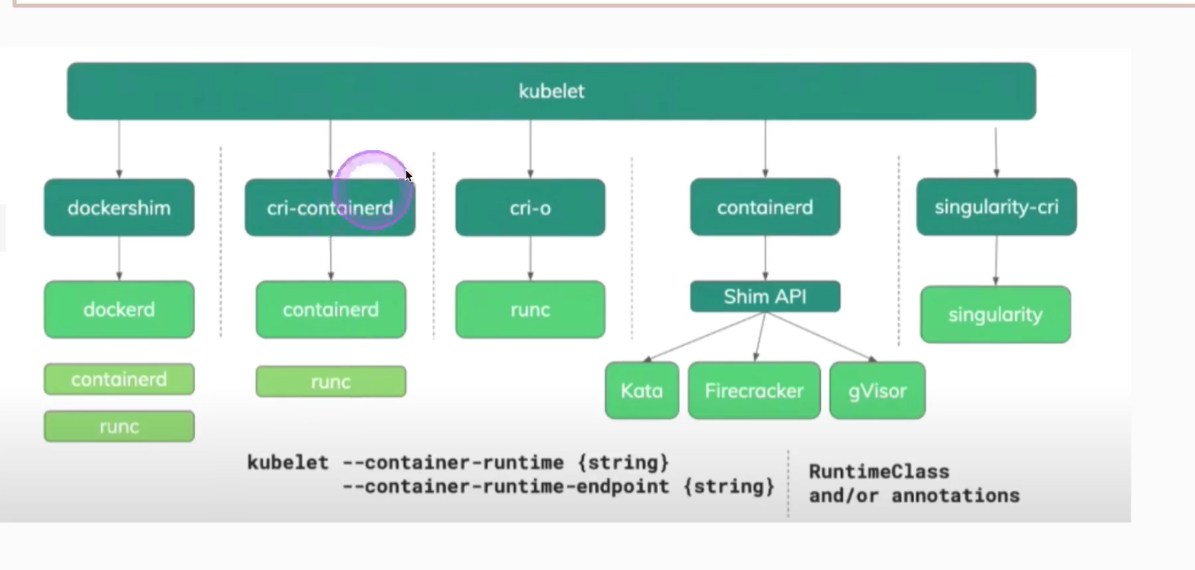
CKS exam topic: container runtimes — concepts, configuration, and practice exercises.

1
2
3
4
5
6
7
8
9
10
11
12
13
14
15
16
17
18
19
20
21
22
23
24
25
26
27
28
29
30
# go inside of a container and call
root@scw-k8s:~# k exec -it pod -- sh
/ # uname -r
5.4.0-96-generic

# step outside of a container and call
root@scw-k8s:~# strace uname -n
execve("/bin/uname", ["uname", "-n"], 0x7fff04c24c98 /* 24 vars */) = 0
brk(NULL)                               = 0x55bfd0cf3000
access("/etc/ld.so.nohwcap", F_OK)      = -1 ENOENT (No such file or directory)
access("/etc/ld.so.preload", R_OK)      = -1 ENOENT (No such file or directory)
openat(AT_FDCWD, "/etc/ld.so.cache", O_RDONLY|O_CLOEXEC) = 3
fstat(3, {st_mode=S_IFREG|0644, st_size=23538, ...}) = 0
mmap(NULL, 23538, PROT_READ, MAP_PRIVATE, 3, 0) = 0x7f6e56b83000
close(3)                                = 0
access("/etc/ld.so.nohwcap", F_OK)      = -1 ENOENT (No such file or directory)
openat(AT_FDCWD, "/lib/x86_64-linux-gnu/libc.so.6", O_RDONLY|O_CLOEXEC) = 3
read(3, "\177ELF\2\1\1\3\0\0\0\0\0\0\0\0\3\0>\0\1\0\0\0\240\35\2\0\0\0\0\0"..., 832) = 832
fstat(3, {st_mode=S_IFREG|0755, st_size=2030928, ...}) = 0
mmap(NULL, 8192, PROT_READ|PROT_WRITE, MAP_PRIVATE|MAP_ANONYMOUS, -1, 0) = 0x7f6e56b81000
mmap(NULL, 4131552, PROT_READ|PROT_EXEC, MAP_PRIVATE|MAP_DENYWRITE, 3, 0) = 0x7f6e5656f000
mprotect(0x7f6e56756000, 2097152, PROT_NONE) = 0
mmap(0x7f6e56956000, 24576, PROT_READ|PROT_WRITE, MAP_PRIVATE|MAP_FIXED|MAP_DENYWRITE, 3, 0x1e7000) = 0x7f6e56956000
mmap(0x7f6e5695c000, 15072, PROT_READ|PROT_WRITE, MAP_PRIVATE|MAP_FIXED|MAP_ANONYMOUS, -1, 0) = 0x7f6e5695c000
close(3)                                = 0
arch_prctl(ARCH_SET_FS, 0x7f6e56b82540) = 0
mprotect(0x7f6e56956000, 16384, PROT_READ) = 0
mprotect(0x55bfced96000, 4096, PROT_READ) = 0
mprotect(0x7f6e56b89000, 4096, PROT_READ) = 0
...
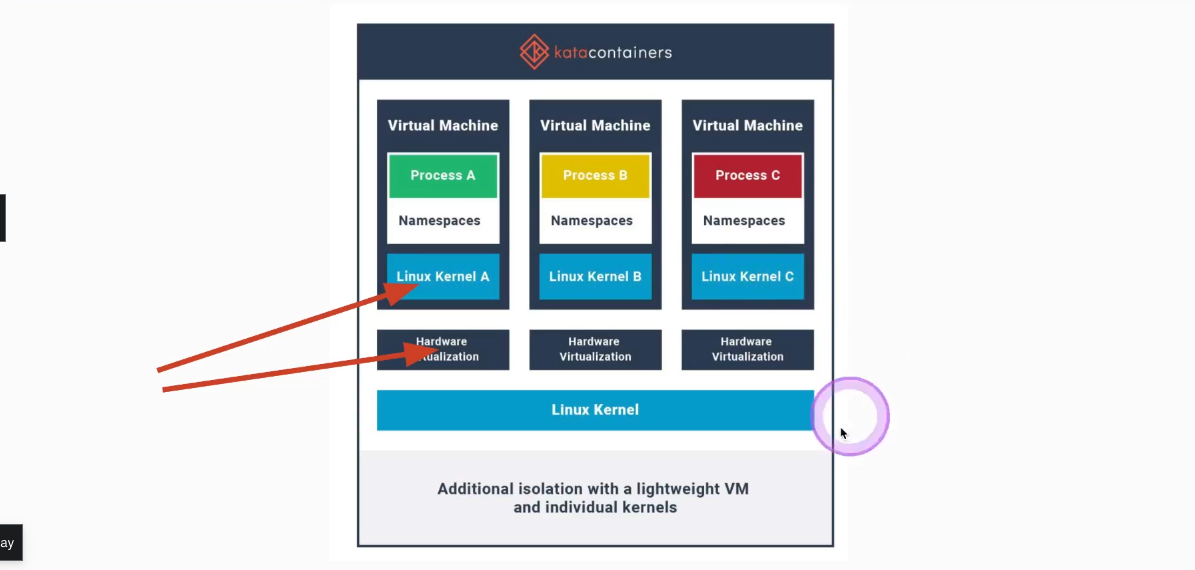
Katacontainers
Katacontainers create a very lightweight VM with a separate kernel (quite different than a traditional containers) Strong separation layer! Using QEMU as default (needs virtualization, like nested virtualization)
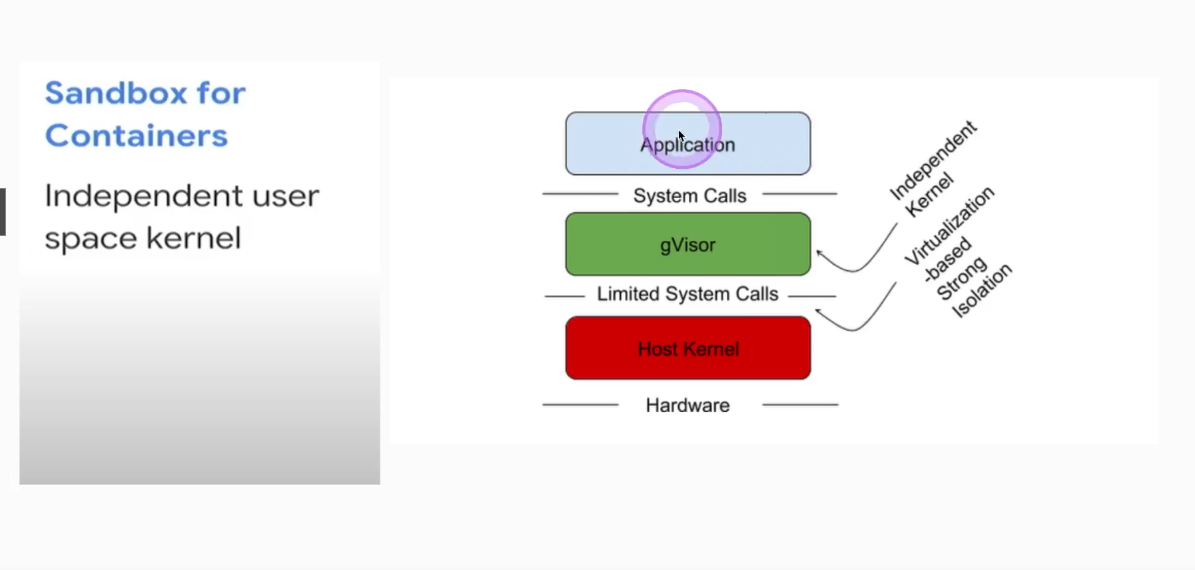
gVisor
- user-space kernel for containers (might be confusing)
- adds another layer of separation
- not hypervisor or VM based
- simulates kernel syscalls with limited functionality (in golang)
- runs in a user space separated from a linux kernel
- runtime is called
runsc
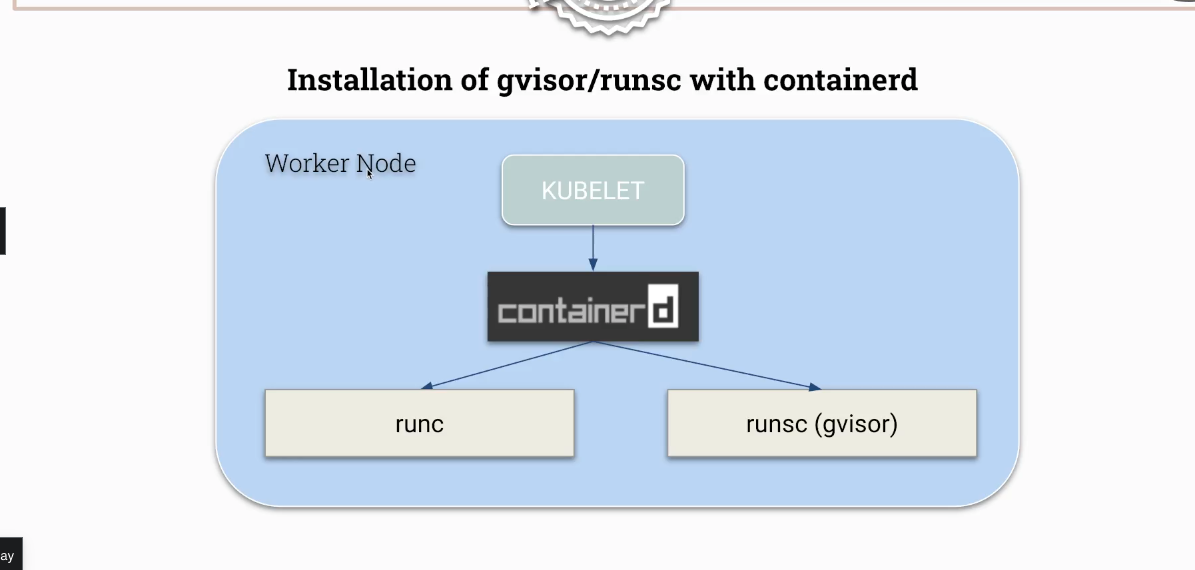
The following script installs gVisor (runsc) and configures containerd to use it as an alternative container runtime. gVisor intercepts application syscalls and provides an additional isolation layer without requiring a full VM.
1
2
3
4
5
6
7
8
9
10
11
12
13
14
15
16
17
18
19
20
21
22
23
24
25
26
27
28
29
30
31
32
33
34
35
36
37
38
39
40
41
42
43
44
45
46
47
48
49
50
51
52
53
54
55
56
57
58
59
60
61
62
63
64
65
66
67
68
69
70
71
#!/usr/bin/env bash
# IF THIS FAILS then you can try to change the URL= further down from specific to the latest release
# https://gvisor.dev/docs/user_guide/install


# gvisor
sudo apt-get update && \
sudo apt-get install -y \
    apt-transport-https \
    ca-certificates \
    curl \
    gnupg-agent \
    software-properties-common


# install from web
(
  set -e
  ARCH=$(uname -m)
  URL=https://storage.googleapis.com/gvisor/releases/release/20210806/${ARCH}
  # URL=https://storage.googleapis.com/gvisor/releases/release/latest/${ARCH} # TRY THIS URL INSTEAD IF THE SCRIPT DOESNT WORK FOR YOU
  wget ${URL}/runsc ${URL}/runsc.sha512 \
    ${URL}/containerd-shim-runsc-v1 ${URL}/containerd-shim-runsc-v1.sha512
  sha512sum -c runsc.sha512 \
    -c containerd-shim-runsc-v1.sha512
  rm -f *.sha512
  chmod a+rx runsc containerd-shim-runsc-v1
  sudo mv runsc containerd-shim-runsc-v1 /usr/local/bin
)


# containerd enable runsc
cat > /etc/containerd/config.toml <<EOF
disabled_plugins = []
imports = []
oom_score = 0
plugin_dir = ""
required_plugins = []
root = "/var/lib/containerd"
state = "/run/containerd"
version = 2

[plugins]
  [plugins."io.containerd.grpc.v1.cri".containerd.runtimes.runsc]
    runtime_type = "io.containerd.runsc.v1"

  [plugins."io.containerd.grpc.v1.cri".containerd.runtimes]
    [plugins."io.containerd.grpc.v1.cri".containerd.runtimes.runc]
      base_runtime_spec = ""
      container_annotations = []
      pod_annotations = []
      privileged_without_host_devices = false
      runtime_engine = ""
      runtime_root = ""
      runtime_type = "io.containerd.runc.v2"

      [plugins."io.containerd.grpc.v1.cri".containerd.runtimes.runc.options]
        BinaryName = ""
        CriuImagePath = ""
        CriuPath = ""
        CriuWorkPath = ""
        IoGid = 0
        IoUid = 0
        NoNewKeyring = false
        NoPivotRoot = false
        Root = ""
        ShimCgroup = ""
        SystemdCgroup = true
EOF

systemctl restart containerd
Then you can create a runtimeClass and pod using that particular runtimeClass
1
2
3
4
5
apiVersion: node.k8s.io/v1
kind: RuntimeClass
metadata:
  name: gvisor
handler: runsc
Create a pod itself
1
2
3
4
5
6
7
8
9
10
11
12
13
14
15
---
apiVersion: v1
kind: Pod
metadata:
  labels:
    run: gvisor
  name: gvisor
spec:
  runtimeClassName: gvisor
  containers:
    - image: nginx
      name: gvisor
      resources: {}
  dnsPolicy: ClusterFirst
  restartPolicy: Always
This post is licensed under CC BY 4.0 by the author.